

Plates on the floor are the single most common tripping hazard in a home gym, and they are also how rubber bumpers develop flat spots and cast iron develops rust rings. The fix costs $40 to $150 and takes an afternoon. Here is how to store plates and bars in rooms of any shape.
Get Plates Off the Floor First
Concrete wicks moisture upward continuously, which is why cast iron plates stacked on a garage floor develop rust on the bottom face while the top looks fine. Rubber bumpers sitting on their edge for months develop flat spots that make them wobble when you load them.
Vertical storage on a peg solves both. Plates hang on their own hole, contact one small point rather than resting on a flat face, and take up roughly 2 square feet regardless of how many you own. A weight tree holding 300 pounds occupies less floor than four plates lying flat.
If you own no storage at all today, a plate tree at $50 to $80 is the single highest-return purchase in this article.
Storage Options by Room Type
| Method | Floor Space | Best For |
|---|---|---|
| Plate tree | 2 sq ft | Any room, most plates |
| Rack-mounted pegs | 0 sq ft | Rooms with a rack |
| Wall-mounted pegs | 0 sq ft | No rack, stud wall |
| Vertical bar holder | 1 sq ft | Two to four bars |
| Horizontal wall rack | 0 sq ft | Bars, above head height |
Anything reading zero uses wall or existing equipment, which is free space you already paid for. Rack-mounted pegs are the best value if you own a rack, since they add capacity without adding footprint and they keep weight close to where you load it.
Keep Plates Within Six Feet of the Bar
This is the layout rule people skip. Walking 12 feet with a 45 pound plate gets old by the second week, and storage that is inconvenient becomes storage you stop using.
Put your heaviest plates closest to the loading position and lighter ones further out, since you handle 45s far more often than 5s. Split storage across two trees on either side of the bar if your room allows, which halves the walking and keeps both sleeves supplied.
Order plates largest at the back, smallest at the front on each peg. It looks tidier and it means the plate you reach for is the one in front.
Bars Store Vertically, With One Exception
A 7 foot bar leaning against a wall consumes 7 feet of usable wall and slides sideways every time someone walks past. Standing upright in a vertical holder it takes about 1 square foot.
Vertical holders need a weighted or anchored base, since a 45 pound bar has a high center of gravity when stood on end. Wall-mounted horizontal hangers are the alternative, installed above head height where nothing else can go.
The exception is bars with unusual geometry. An EZ curl barbell will not seat properly in a standard vertical tube because of the bend, and it stores better on a horizontal hanger or a short wall bracket. Sleeve diameter varies too, and standard barbells under 200 dollars use 1 inch sleeves that rattle in holders built for 2 inch Olympic bars. Measure before you buy a holder, since the full barbell lineup spans both sizes.
Match Storage Capacity to What You Own
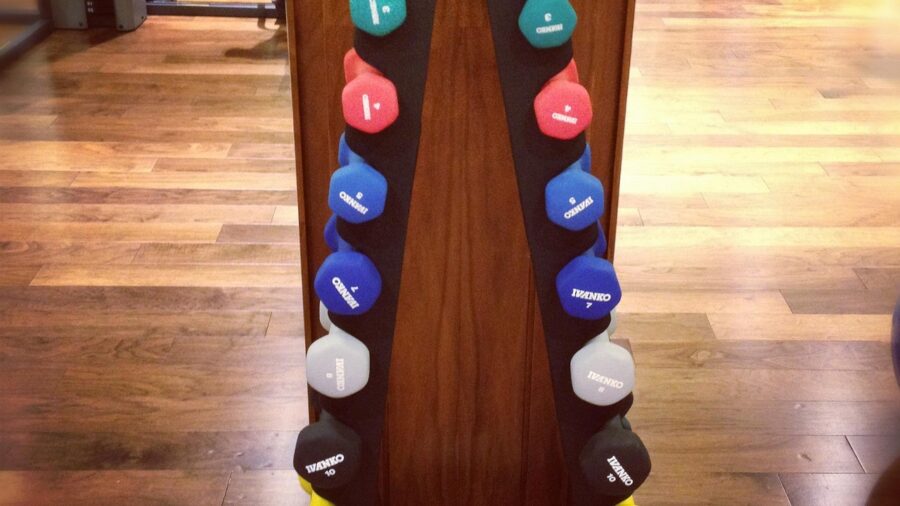
A standard plate tree holds six to eight plates per peg and roughly 300 to 500 pounds total. If you own 400 pounds of plates, one tree is tight and two is right.
Check the tree’s post diameter against your plates. Olympic plates need 2 inch posts, standard plates need 1 inch, and a mismatch means plates either will not fit or rattle loosely. Bar storage capacity matters too: many trees include two bar holders, which covers most setups. Heavier bars like these Titan Fitness barbells under 400 dollars weigh 45 pounds each, so confirm the holder is rated for the combined load if you are stacking three or four.
You Might Not Need Any of This
Here is the honest part. If you own one bar and 200 pounds of plates, a $120 storage system is solving a problem you do not have.
Four plates and a bar lined up neatly against a wall, out of the walking path, cost you nothing and function fine. Storage systems earn their footprint past roughly 300 pounds of plates or when the equipment shares a room with living space and visual tidiness matters.
Below that, spend the money on more plates instead. The room will tell you when it is time, usually the first time you catch your toe on a 25.
Get everything off the floor, keep plates within six feet of the bar, stand bars upright, and match post diameter to your plates. The rest of the gym design guides cover the layout around it.





Write Your Review
No reviews yet. Be the first to share your experience!