

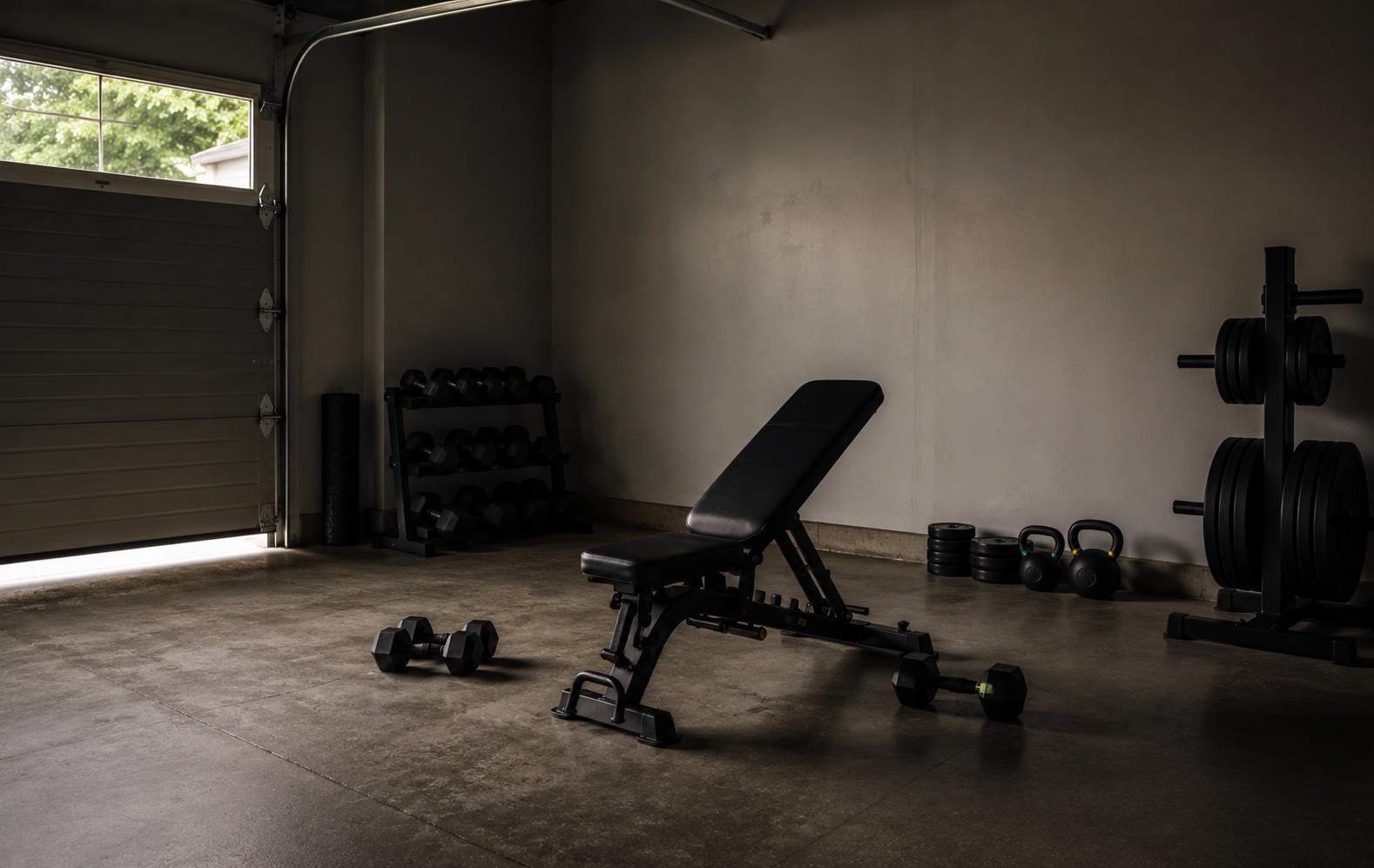
A weight bench is the piece of gym home equipment most likely to spend its life in the wrong place. It’s too heavy to move casually, too big to ignore, and too awkward to lean anywhere without something eventually falling over. Storing it properly protects the upholstery, keeps the adjustment mechanism working, and buys back floor space you’re currently donating to a padded rectangle.
Clean and Dry It Before Storing
This is the step that determines whether your bench looks the same in three years. Sweat left on vinyl breaks down the material from the surface inward, and moisture trapped against a folded pad has nowhere to go.
Wipe the pad with mild soapy water, paying attention to the seams where sweat collects and the underside where it runs down. Dry the pad completely before folding or standing the bench up, since a folded damp pad becomes a mildew problem within days.
Wipe the frame too, especially around the adjustment brackets and any exposed pivot hardware. If your bench has bare metal at the hinge points, a light silicone spray before storage prevents surface rust from forming while it sits.
Pick the Right Storage Position
Benches can be stored in three positions, and each one suits different equipment and spaces.
| Position | Space Used | Best For | Watch Out For |
|---|---|---|---|
| Upright on end | Smallest, roughly 2 sq ft | Flat and light adjustable benches | Tipping, wall scuffs |
| Folded flat | Small, stores under furniture | Purpose-built folding benches | Hinge stress if forced |
| Rolled aside on wheels | Same footprint, relocated | Heavy benches with attachments | Floor marks, needs clear path |
Standing a bench on end is the most space-efficient option for most people, but it only works safely if the base is wide enough to be stable. A narrow bench standing upright in a room where anyone walks past is a falling object waiting for a reason.
Store It Upright Without Damaging Anything
Stand the bench on its heaviest end, which is usually the foot of the frame rather than the head. Position it against a wall, not free-standing, and angle the base slightly outward so it leans into the wall rather than balancing vertically.
Put something between the bench and the wall. A scrap of rubber mat or a felt pad prevents the frame from scuffing paint and stops the bench from sliding sideways. If you have children or pets in the house, secure the bench with a strap anchored to a stud rather than trusting gravity.
Never store a bench upright with the pad facing a wall in a damp room. Compressed vinyl against a cool surface is where condensation forms. Face the pad outward so air circulates.
Lighter adjustable benches handle this best. Models from our roundup of the best adjustable weight benches under 200 dollars are generally light enough to stand up and move without a second person.
Folding and Wheeled Options Make This Easier
If storage is a recurring frustration, the bench itself may be the problem. Purpose-built folding benches collapse to a fraction of their open size and are designed for repeated folding, which matters because hinges built for the job last far longer than ones you’re forcing.
Our review of the best foldable weight benches covers models that fold flat enough to slide under a bed or behind a door. Fold them slowly, keep hands clear of the hinge, and never leave a bench half-folded, since partial tension on a locking mechanism wears it out.
Benches with attachments are the hardest to store because leg extension and curl arms add length and weight. Models in our roundup of the best weight benches with leg extension under 200 dollars often have removable attachment pins, which lets you detach the arms and store the components separately. Heavier combination units from our list of the best weight benches with leg extension and curl from 200 to 400 dollars are usually better left in place and simply rolled aside if they have transport wheels.
Long-Term Storage Considerations
If a bench is going away for months rather than days, a few extra steps prevent unpleasant surprises.
- Avoid garages and unheated spaces: Temperature swings crack vinyl and drive condensation into the frame.
- Cover with breathable fabric: An old sheet works. Plastic tarps trap moisture and cause the exact damage you’re preventing.
- Keep it off bare concrete: Concrete wicks moisture upward. A scrap of rubber mat under the feet solves it.
- Store flat if possible: Long-term upright storage puts constant load on one end of the frame.
- Loosen adjustment to neutral: Leaving a backrest under tension for months stresses the mechanism.
Check on it occasionally. A bench stored and forgotten for a year has a way of developing problems nobody noticed.
Fold Storage Into Your Care Routine
Storage habits and maintenance habits are the same habits. Wiping down before storing is the same wipe-down that prevents bacteria and corrosion, and checking the adjustment mechanism when you fold it is the same check that catches wear early.
Our gym home equipment maintenance schedule covers where bench hardware checks fit alongside your other monthly tasks, and more equipment-specific routines live in our gear care category. If storage frustration has you considering a replacement, our full weight benches category lists folded dimensions alongside the usual specs.
Clean it, dry it, stand it against a wall with something soft in between, and strap it if anyone under four feet tall lives in your house. That’s the entire job.




Write Your Review
No reviews yet. Be the first to share your experience!