

You can build a genuinely strong body with nothing but a pair of dumbbells and a patch of floor. No rack, no barbell, no spotter, no waiting for anything. Dumbbells work each side independently, which exposes weaknesses a barbell lets you hide, and they take up roughly the space of a shoebox. For most gym home setups, that combination is hard to beat.

Why Dumbbells Are Enough
The common objection is that you can’t load dumbbells as heavy as a barbell. True, but mostly irrelevant. Unilateral work means each arm or leg handles its own load, so a 50-pound dumbbell in each hand produces a comparable training stimulus to a considerably heavier barbell.
Dumbbells also allow a natural range of motion. Your wrists and shoulders rotate freely instead of being locked into a fixed bar path, which tends to be kinder to joints over years of training. The greater stability demand recruits more supporting musculature per rep.
The practical advantages matter too: no setup time, no safety bars needed, and you can drop them without destroying your floor or your confidence. Our full dumbbells category covers the range of options if you’re still building your set.
The Full-Body Workout
Run this three times per week on non-consecutive days. Three sets of 8 to 12 reps unless noted, resting 60 to 90 seconds between sets.
- Goblet squat: One dumbbell held at chest height. Sit between your heels, keep the chest tall.
- Dumbbell Romanian deadlift: Slight knee bend, push hips back, feel the hamstrings stretch before returning.
- Flat or floor press: On a bench or the floor. Floor presses limit range slightly but protect the shoulders.
- Single-arm row: One knee braced, pull to the hip. Three sets per side.
- Standing overhead press: Press without arching the lower back. Brace the core throughout.
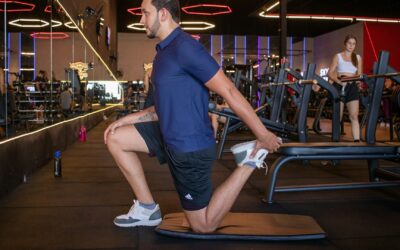
- Walking or reverse lunge: Two sets of 10 per leg. Reverse lunges are easier on the knees.
- Renegade row or plank: Two sets. Core work that doubles as shoulder stability training.
That’s about 40 minutes including a warmup. Do a few minutes of easy movement and some light sets before the first working set, since cold shoulders and heavy presses are a poor combination.
Progressing Without a Rack of Weights
Adding weight is the obvious progression, but a limited dumbbell set means you’ll run out of jumps quickly. These variables give you months of progress without buying anything.
- Add reps: Work from 8 up to 15 before increasing weight.
- Slow the eccentric: Three seconds lowering makes the same weight substantially harder.
- Add sets: Move from three to four or five sets per movement.
- Shorten rest: Drop from 90 seconds to 45 to increase density.
- Harder variations: Bulgarian split squats instead of lunges, single-leg RDLs instead of double.
- Pause reps: Two seconds at the hardest point of the movement.
Change one variable at a time and hold it for two to three weeks. Changing everything at once means you can’t tell what worked.
Choosing Dumbbells That Suit the Plan
For a plan this varied, grip quality matters more than any other feature. You’ll be holding these through squats, presses, and rows, and a slipping dumbbell mid-press is genuinely dangerous. Our roundup of the best non-slip grip dumbbells covers knurling and coating that hold up when your hands are sweaty.
Hex-shaped dumbbells are the practical default. They don’t roll away, they sit flat for renegade rows and pushups, and they’re the most durable shape. Our review of the best hex dumbbells covers sets that suit exactly this kind of programming.
If your gym home lives in a garage or basement, corrosion becomes a factor. Our list of the best rust-resistant dumbbells under 500 dollars covers coated options that survive humid spaces. And if you plan to add conditioning circuits, our roundup of the best dumbbells for HIIT workouts under 300 dollars covers sets built for faster transitions.

Know Your Baseline Before You Start
Strength training changes your metabolism, and understanding where you’re starting from helps you eat appropriately for your goal. Basal metabolic rate determines how many calories your body burns at rest, and muscle gained through resistance training raises that number over time.
Our BMR calculator gives you a starting figure. Eat slightly above it to build, slightly below to lean out, and stop guessing based on how full you feel.
Adding Cardio Without Undermining Strength
Three lifting days leaves room for conditioning, but placement matters. Keep hard cardio off your lifting days where possible, or at minimum put it after the weights.
Steady-state work is the easiest to recover from and pairs well with a three-day lifting week. Our beginner cardio workout plan covers a progression that won’t compete with your strength sessions.
If you prefer intervals, cap it at two sessions weekly and keep them short. Our HIIT treadmill workout guide covers protocols that deliver conditioning without eating into recovery.
Run these seven movements three times a week for eight weeks before you change anything. Dumbbell training rewards consistency far more than it rewards variety, and the plan only looks simple until you’re four sets deep into goblet squats.



Write Your Review
No reviews yet. Be the first to share your experience!