

Most people quit the elliptical because 35 minutes at a steady pace is genuinely boring. The machine is not the problem. The programming is. Change the variables every three to five minutes and the same 35 minutes passes without you watching the clock once. Here is the session.
Why Steady State Feels So Long
Your brain tracks novelty, not effort. A constant resistance level and unchanging stride rate means there is nothing to pay attention to, so you default to counting down minutes.
Varying resistance, direction, incline, and handle use gives you something to execute rather than endure. The physiological benefit is real too, since intensity variation improves cardiovascular adaptation more than steady work at the same average heart rate. But the practical benefit is simpler: you stop noticing the time.
The Four Variables You Can Change
Resistance shifts muscular demand. Incline, where available, moves emphasis between quads and glutes. Direction reverses the stride to load hamstrings instead of quads. Handles determine whether your upper body works or rests.
Machines differ in how many of these you get. Basic units offer resistance only, which is enough for a decent session but limits variety. Incline-capable models across the elliptical lineup open up the full version of this workout.
The 35 Minute Block Session
| Minutes | Focus | Setting |
|---|---|---|
| 0 to 5 | Warm-up | Resistance 3, hands off |
| 5 to 9 | Arms only | Resistance 6, push-pull focus |
| 9 to 13 | Reverse stride | Resistance 5, hands off |
| 13 to 18 | Hill climb | Incline high, resistance 8 |
| 18 to 22 | Sprint intervals | 30 sec fast, 30 sec easy |
| 22 to 27 | Reverse hill | Incline mid, backward |
| 27 to 30 | Power finish | Resistance 9, full body |
| 30 to 35 | Cool-down | Resistance 2, easy pace |
No block runs longer than five minutes, which is roughly the point where attention starts to drift. Each transition gives you a new task, and the session ends before monotony sets in.
Reverse Stride Is the Underused One
Pedaling backward is the most overlooked feature on any elliptical. Forward motion loads quads and hip flexors. Reversing shifts emphasis to hamstrings and glutes, which most cardio neglects entirely.
It also demands coordination, particularly when you are tired, which is exactly the kind of attention that makes time pass. Start with two minute blocks until the pattern feels natural, then extend. Keep posture tall and grip light. Leaning on the console to stay upright means you need less resistance, not more.
Use Your Arms Deliberately, Not Passively
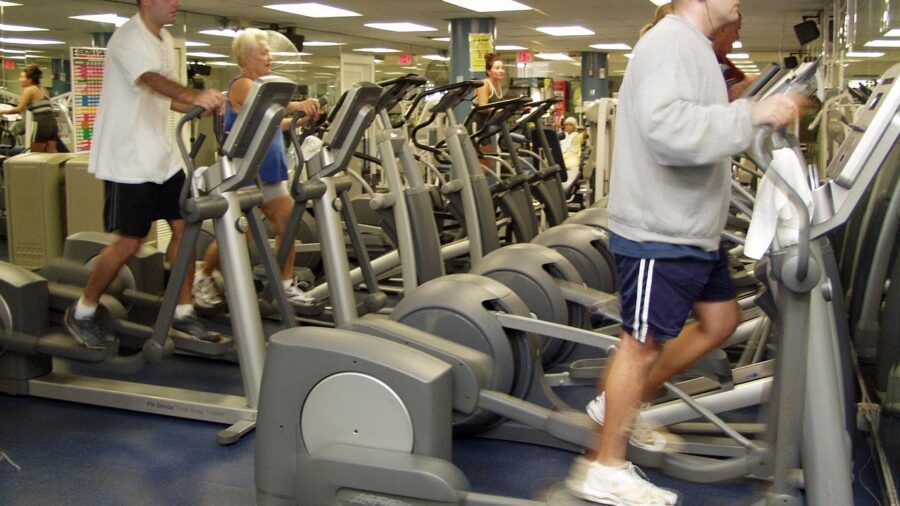
Most people rest their hands on the moving handles and let their legs drive everything. That turns a full-body machine into a leg machine.
During the arms-only block, reduce leg effort deliberately and drive the handles with a push-pull action, as if you were doing a standing row alternated with a press. Your legs still move, but the upper body leads. Four minutes of this is genuinely hard and takes zero additional time.
Machine build quality shows here. Heavier flywheels handle upper body input without the stride feeling loose, which is one reason commercial ellipticals for home offices over 1500 dollars feel different under load than lighter frames. Solid mid-range options like these ellipticals for gym home setups under 2000 dollars handle it fine too.
The Machine Matters Less Than the Programming
Here is the honest part. You do not need an expensive elliptical to run this session. Resistance changes alone cover roughly 70 percent of the variety, and a quiet elliptical under 200 dollars does that fine.
What you lose without incline is the hill blocks, which you can substitute with longer resistance intervals. What you lose on a lighter frame is stability during the arms-only work. Neither is worth $1,500 if your alternative is not training at all. Even an under-desk elliptical covers low-intensity volume, though not this session.
If you are still deciding between machine types, this comparison of treadmill versus elliptical for home cardio covers the tradeoffs, and the broader cardio machine category lays out the alternatives.
Run this three times a week and change the block order occasionally so it does not become its own routine. Follow it with this elliptical cool-down routine. Boredom is a programming problem, not a machine problem.







Write Your Review
No reviews yet. Be the first to share your experience!