
Smith machine training produces a different soreness pattern than free weights, and the reason is the fixed bar path. Your stabilizers do almost nothing while your prime movers take the full load, which concentrates fatigue in the quads, glutes, and lower back rather than spreading it. The recovery work should reflect that.
Why the Fixed Bar Path Changes Your Soreness
On a free barbell squat, your hips, ankles, and core constantly adjust to keep the bar over midfoot. On a Smith machine the rails handle that, so those stabilizers contribute little and the quads absorb more of the total work.
The angled rail adds a second factor. Most machines run a 7 to 12 degree slope, which shifts your foot position forward relative to the bar and loads the quads more heavily than a free squat at the same weight. Lifters routinely find their quads noticeably sorer after Smith squats than after barbell squats with 30 pounds more on the bar.
Lower back soreness comes from the opposite direction. Your spine adapts to a bar path it did not choose, and that mismatch shows up as erector stiffness the next morning.
The First 15 Minutes
Walk for 5 minutes before you sit down. Circulation is still elevated and this clears more from the quads than any stretch in the same window.
Then three positions, 45 seconds each side:
- Standing quad pull: squeeze the glute on the working side to keep the pelvis neutral. Most people skip this and stretch their knee instead of their quad.
- Half-kneeling hip flexor: back knee down, pelvis tucked under. If you feel it in your lower back, the tuck is missing.
- Cat-cow: 60 seconds of slow reps to unload the erectors.
The full body version is covered in this cool-down stretching routine after strength training, which handles the upper body this session skips.
Recovery by Soreness Location
| Sore Area | Likely Cause | What Helps |
|---|---|---|
| Quads | Angled rail, foot position | Quad stretch, walking |
| Lower back | Fixed path mismatch | Cat-cow, 90/90 |
| Upper traps | Bar sits higher | Neck and trap stretch |
| Front delts | Fixed press path | Doorway chest stretch |
Map your soreness against this before assuming you overtrained. Front delt tightness after Smith bench is a path issue, not a volume issue, and dropping sets will not fix it.
The Day After Matters More
Mobility work 24 hours later produces better results than what you do immediately after, because tissue temperature is normalized and you can actually control the range.
Spend 10 minutes on loaded mobility rather than passive holds. A goblet squat hold with a light weight for 60 seconds teaches your nervous system to accept the range instead of borrowing it temporarily. Add a 90/90 hip rotation for 10 controlled reps per side, which addresses the hip mobility a fixed bar path never demands.
Give 48 hours before repeating a heavy Smith session. If you pull heavy in the same week, this guide on recovering from a heavy barbell deadlift session covers how to space the two so lower back load does not stack.
Lower Back Pain Is a Setup Problem
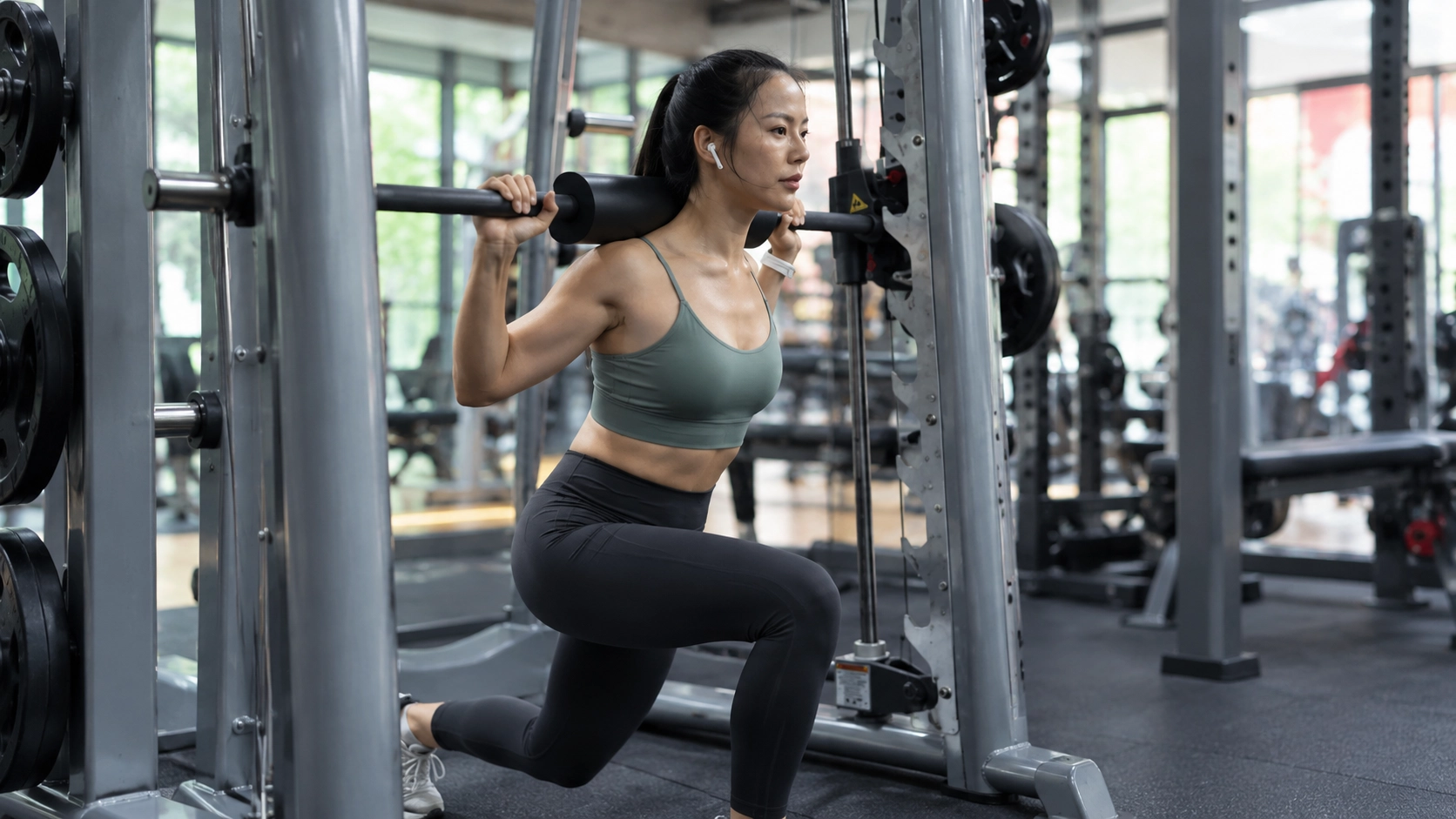
Normal erector stiffness is diffuse and improves with movement. Sharp or one-sided pain after Smith squats almost always traces to foot placement rather than weight.
Feet too far forward pushes your lower back into flexion at the bottom. Feet too far back does the opposite. The fix is positioning, not stretching, and no amount of recovery work compensates for a setup that fights the rail angle every rep. Rail angle varies across the Smith machine lineup, so a position that works on one frame may not transfer to another.
Recovery Load Depends on What Your Machine Lets You Do
Here is the practical note. A base Smith machine limits you to pressing and squatting patterns, which means your posterior chain gets less work and your quads get more. That imbalance is itself a recovery issue over months.
Machines with pulling stations even it out. A Smith machine with a lat pulldown under 1000 dollars adds vertical pulling, and all-in-one Smith machines under 5000 dollars add rows and face pulls that counterbalance the pressing volume. Compact units like a Smith machine for small spaces under 500 dollars usually skip these, so program band work to fill the gap.
Heavier loading changes the timeline too. Lifters using Smith machines built for heavy lifters should treat 72 hours as the floor between hard leg sessions, not 48.
Walk, stretch quads and hips, fix your foot position, and do the real mobility work on day two. The rest of the recovery phase guides cover sleep and nutrition.



Write Your Review
No reviews yet. Be the first to share your experience!