
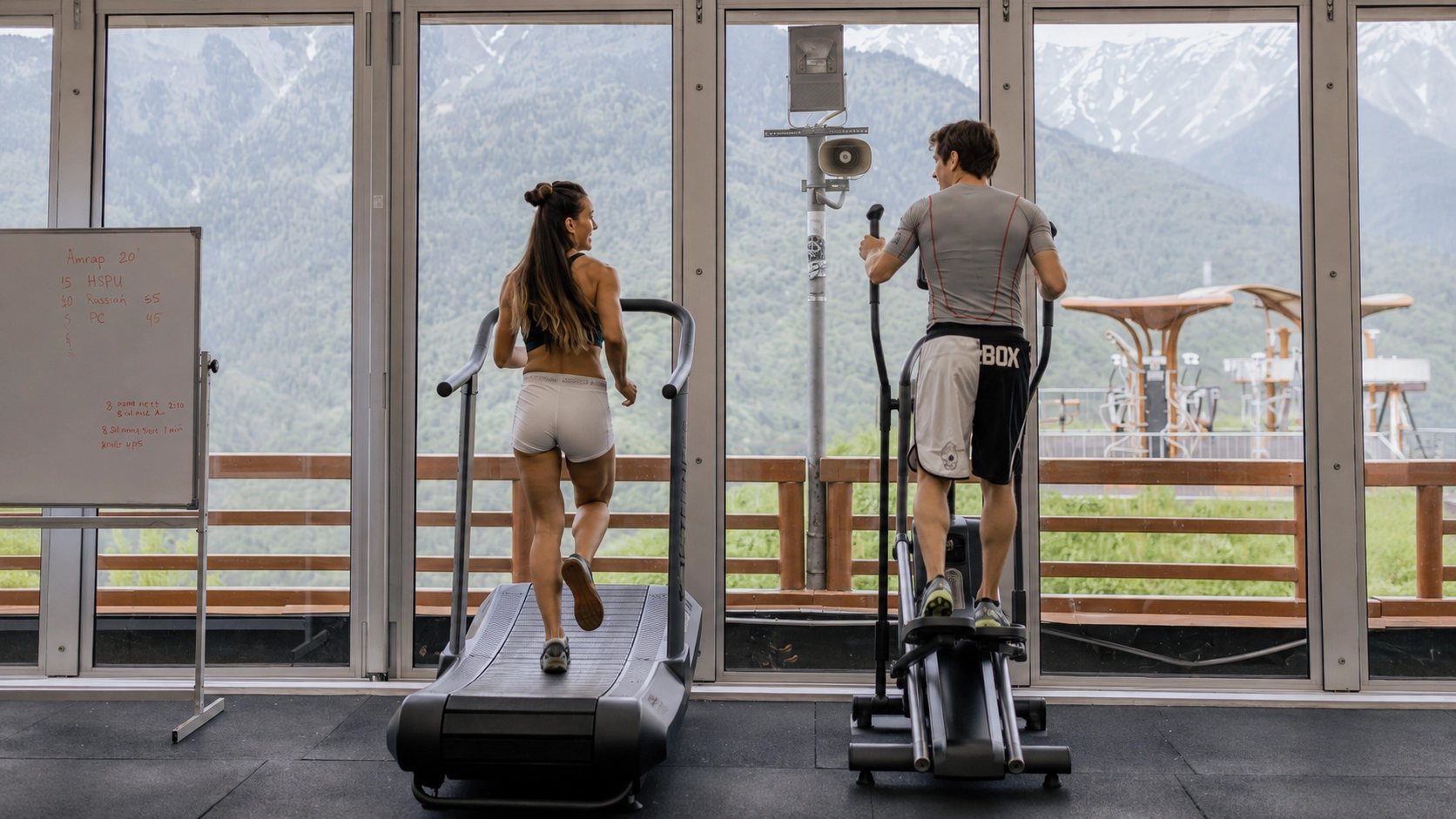
Treadmill or elliptical is the cardio question almost every gym home owner faces, usually while standing in a garage trying to figure out what will fit. Both machines burn calories, improve heart health, and can be used year round regardless of weather. The right choice comes down to your joints, your goals, and how much space you’re willing to surrender.
How the Two Machines Actually Differ
Treadmills replicate walking and running, which means your feet leave the surface and land with each stride. That impact builds bone density and translates directly to real-world running performance, but it also stresses knees, hips, and ankles.
Ellipticals keep your feet planted on moving pedals throughout the stride, eliminating impact entirely. Most models also include moving handles that engage your upper body, spreading effort across more muscle groups. The trade-off is that the motion is guided rather than natural, so it doesn’t build running-specific fitness.
| Factor | Treadmill | Elliptical |
|---|---|---|
| Joint impact | Moderate to high | Very low |
| Calorie burn | Higher at equal effort | Slightly lower, more distributed |
| Upper body use | Minimal | Significant with moving handles |
| Typical footprint | Larger, longer | Slightly smaller, taller |
| Maintenance needs | Belt, deck, motor | Minimal, mostly bearings |
| Noise level | Louder, especially running | Quieter |
Which Burns More Calories
At equal perceived effort, treadmills generally edge out ellipticals, particularly once you add incline or start jogging. Running is simply more metabolically demanding than gliding. That said, the difference is smaller than most people assume, and it disappears entirely if you push harder on the elliptical than you would on the treadmill.
What matters far more is duration and consistency. Daily calorie burn depends heavily on body weight, activity level, and metabolism, so machine choice is a smaller factor than how often you use it. Run the numbers for your own body with our calories burned calculator rather than trusting the optimistic display on either machine.
If weight loss is the goal, pair whichever machine you choose with a realistic target. Our ideal weight calculator gives you a sensible range based on height and frame instead of an arbitrary number.
Joint Health and Injury History
This is the deciding factor for a lot of buyers. If you have knee issues, arthritis, a history of shin splints, or you’re carrying significant weight, the elliptical is the safer starting point. Zero impact means you can train longer and more frequently without accumulating joint stress.
Treadmills still have real advantages, though. Treadmill running offers weight-bearing benefits for bone density alongside its cardiovascular effects, which ellipticals cannot match. Walking on a treadmill at an incline is also a low-impact option that many people overlook, delivering serious calorie burn without any jogging.
If you’re comparing elliptical models specifically, our review of the best Niceday elliptical machines for gym home use covers options with smooth stride paths that feel natural rather than mechanical.
Space, Noise, and Practical Constraints
Treadmills are long. Most need 70 to 80 inches of length plus clearance behind them for safety. Ellipticals are shorter but taller, which matters in basements with low ceilings or under sloped garage roofs. Measure your ceiling height before buying an elliptical, since the pedal arc adds several inches to your standing height.
Noise is worth serious thought in apartments or shared homes. Running on a treadmill is audible through floors and walls. Ellipticals are considerably quieter, making them the better pick for early morning sessions or upstairs rooms.
For ellipticals in the mid-price range, our roundup of the best elliptical machines for gym home setups under 2000 dollars covers models that balance build quality with reasonable footprint.
When a Bike Beats Both
Sometimes the honest answer is neither. If your ceiling is low, your floor space is minimal, or your budget is tight, an exercise bike delivers comparable cardio benefits in the smallest footprint of the three.
Bikes are the cheapest entry point, the quietest option, and the easiest to store. Models with guided classes keep motivation high, and our review of the best exercise bikes with app connectivity under 500 dollars covers affordable picks with built-in programming. For truly tight spaces, our list of the best folding exercise bikes under 1000 dollars features models that disappear between sessions.
Choose the treadmill if you want running fitness, weight-bearing benefits, and have the space and joint tolerance for it. Choose the elliptical if joint protection, quieter operation, and full-body engagement matter more. Either way, the machine you use four times a week beats the one that looked better on paper.


Write Your Review
No reviews yet. Be the first to share your experience!