
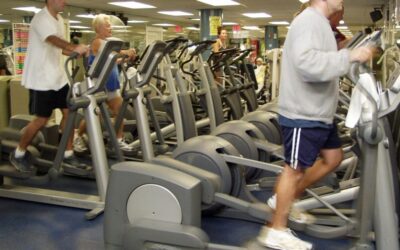
Indoor cardio dehydrates you faster than the same effort outdoors, and most people never account for it. No headwind, no evaporative cooling, just a stationary body producing heat in a room with limited airflow. Sweat rates on a treadmill or bike commonly run 20 to 30 percent higher than outdoor equivalents. Here are the numbers that actually matter.
Know Your Sweat Rate Before You Guess
Weigh yourself naked before a 60 minute session and again immediately after, toweling off first. Every pound lost equals roughly 16 ounces of fluid. Add whatever you drank during the session to get your true sweat rate.
Most people land between 20 and 48 ounces per hour. That range is wide enough that generic advice is useless: a light sweater and a heavy sweater doing the same workout need double the difference in fluid. Do this once in summer and once in winter, since ambient temperature shifts the number considerably. A water intake calculator gives you a daily baseline to build these session numbers on top of.
The Timing Schedule
| Window | Amount | Notes |
|---|---|---|
| 2 hrs before | 16 to 20 oz | Time to void excess |
| 20 min before | 8 oz | Top off, no sloshing |
| During, per 15 min | 4 to 8 oz | Small, frequent sips |
| After, per lb lost | 16 to 24 oz | Spread over 2 hrs |
Drinking during the session is the step people skip because it interrupts rhythm. It should not. Sipping 6 ounces every 15 minutes is far easier to absorb than chugging 24 ounces at the end, and it prevents the performance drop that starts before you feel thirsty.
Electrolytes Past the 60 Minute Mark
Under 60 minutes, plain water is fine. Past that, you are losing sodium at roughly 500 to 1,000 milligrams per liter of sweat, and replacing fluid without sodium can leave you feeling worse rather than better.
An electrolyte tablet or a sports drink covers it. So does a pinch of salt in your bottle if you would rather not buy anything. Salty sweaters, the people who finish a session with white residue on their shirt, sit at the high end of that sodium range and should not skip this. Long steady rides following a plan like this exercise bike workout guide for beginners routinely cross the 60 minute threshold where this starts to matter.
Interval Sessions Change the Math
HIIT produces higher core temperature in less time, which means a 35 minute interval session can cost you as much fluid as 60 minutes of steady work. The problem is that the work intervals leave no comfortable window to drink.
Front-load instead. Take in your 8 ounces during the warm-up, then use each rest interval for a few quick sips rather than trying to drink mid-effort. Sessions built around a HIIT treadmill plan for calorie burn or interval work on a NordicTrack bike built for HIIT both benefit from planning fluid around rest periods instead of improvising.
Airflow Beats Hydration Strategy
Here is the contrarian point. A $30 fan pointed at your torso reduces sweat loss more than any hydration product you can buy. Cooling the body directly means your body sweats less to begin with, which is a better solution than replacing fluid efficiently.
Room placement matters as much as equipment. A compact treadmill for small apartments under 400 dollars squeezed into a closed room with no ventilation will drive up your sweat rate regardless of what is in your bottle, and the same applies to a bike sized for tight spaces in the 300 to 400 dollar range. Larger units like these commercial-grade treadmills for home use from 1000 to 1500 dollars often include built-in fans, which help but rarely replace a real one.
Overhydration Is a Real Thing
Drinking well beyond your sweat rate dilutes blood sodium and causes the same symptoms as dehydration: headache, nausea, sluggishness. General daily intake guidance from Harvard Health on how much water to drink puts most adults in a range far below what fitness culture suggests.
Check urine color rather than counting bottles. Pale yellow is the target. Completely clear usually means you are ahead of what your body needs.
Do the sweat rate weigh-in once, build your schedule around that number, and put a fan in front of the machine. The rest of the fitness nutrition guides cover the fueling side that pairs with this.


Write Your Review
No reviews yet. Be the first to share your experience!