
Rowing recruits about 86 percent of your body’s muscle mass in a single stroke, which is why it does in 25 minutes what a treadmill and a weight machine need 50 to cover. The catch is that most people row wrong, turning a full-body movement into an arm exercise. Here is the technique and the programming that fixes it.
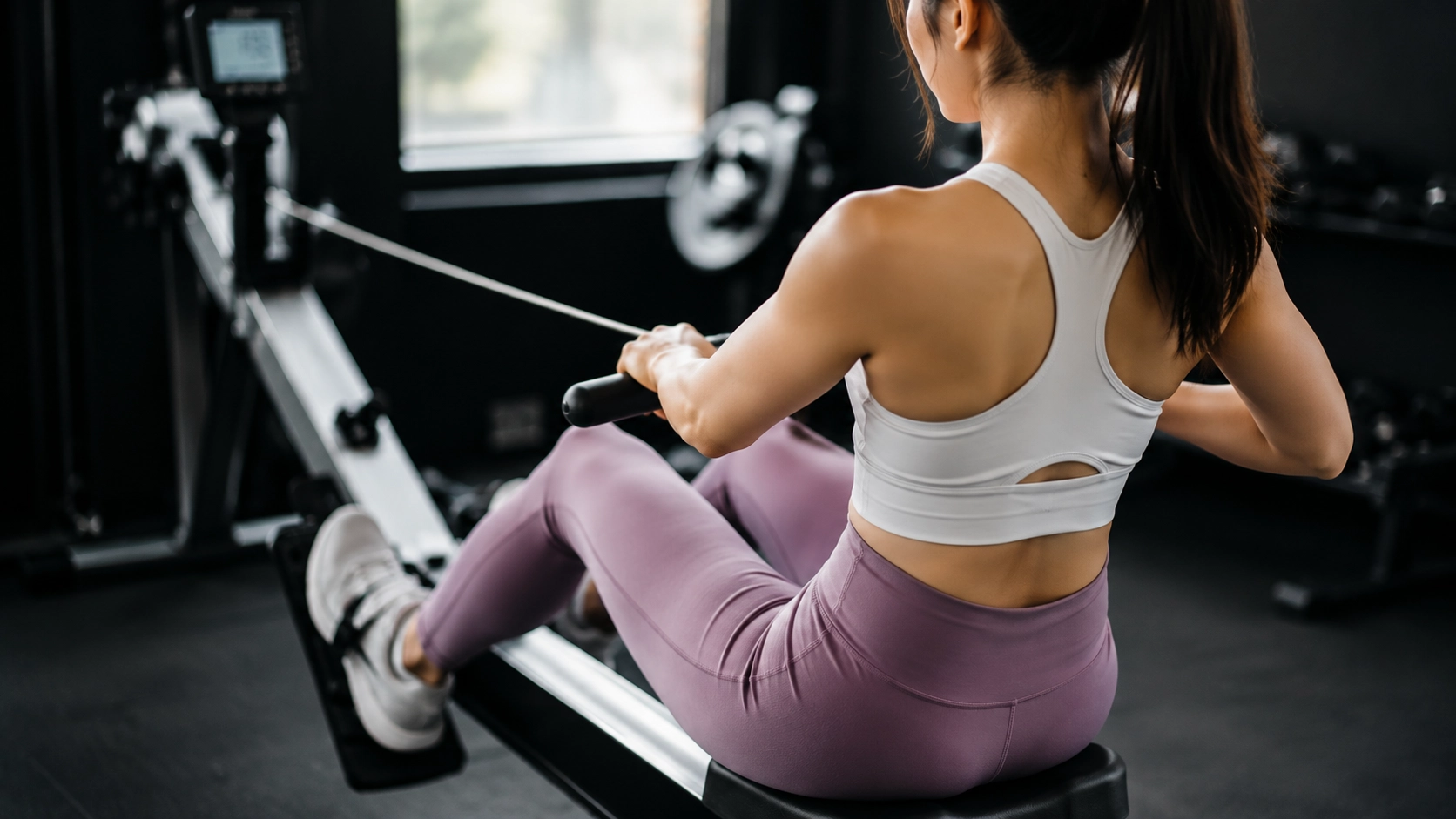
The Stroke Is 60 Percent Legs
Every stroke has four phases in a fixed order: catch, drive, finish, recovery. Power distribution should be roughly 60 percent legs, 30 percent core and hips, 10 percent arms.
At the catch, shins are vertical, arms straight, shoulders in front of hips. The drive starts by pushing the footplate, not pulling the handle. Your legs extend first, then your torso swings back to about 11 o’clock, then your arms finally bend and draw the handle to your lower ribs. Recovery reverses that order exactly: arms out, body forward, then knees bend.
If your arms bend before your legs finish extending, you are rowing with the smallest muscles in the chain. This single correction changes more than any programming adjustment, and it is the reason a proper stroke on any machine in the rowing machine lineup feels harder than what most beginners do.
Stroke Rate and Damper Settings
Damper setting is not resistance. It controls airflow, which changes how the stroke feels, not how hard the work is. Setting it to 10 does not build more muscle. It just makes each stroke slower and heavier, like rowing a barge.
| Session Type | Damper | Stroke Rate |
|---|---|---|
| Steady state | 3 to 4 | 20 to 24 spm |
| Intervals | 4 to 6 | 26 to 30 spm |
| Power strokes | 6 to 8 | 16 to 20 spm |
Most competitive rowers train at 3 to 5. Start there. Your output comes from how hard you push, and a calories burned calculator gives you a realistic estimate for your bodyweight and session length instead of trusting the console readout.
A Three-Session Week
Day 1, steady state: 25 to 30 minutes at 20 to 22 strokes per minute, conversational pace. This builds the aerobic base everything else sits on.
Day 2, intervals: 8 rounds of 500 meters with 90 seconds rest. Target a consistent split time across all eight. If round eight is 15 seconds slower than round one, you started too hard.
Day 3, pyramid: 250m, 500m, 750m, 1000m, then back down, with rest equal to the work interval. Roughly 30 minutes total including rest.
Beginners should cut every distance in half for the first three weeks. A machine sized for that learning phase, like these rowing machines for beginners under 300 dollars, handles this programming fine. You are not limited by the equipment at this stage.
Where the Weight Loss Actually Comes From
A 175 pound person rowing at moderate intensity burns 250 to 350 calories in 30 minutes. Interval sessions push that higher. Neither number matters as much as consistency, and this is where rowing has a practical advantage over most cardio: low joint impact means you can train it five days a week without your knees filing a complaint.
Machines with structured programs help here. Options like NordicTrack rowing machines for weight loss or these rowing machines for weight loss under 1000 dollars handle interval timing automatically, which removes the one thing people actually quit over.
You Do Not Need an Expensive Machine
Here is the honest part. Air resistance rowers are the standard, but a magnetic rower at $250 delivers a nearly identical stroke pattern for the first year of training. The differences show up in stroke feel and data precision, not in what your body gets out of the session.
What does matter is noise and footprint. Air rowers sound like a small aircraft, which is a real problem in an apartment, and low-noise rowing machines in the 300 to 500 dollar range solve that without sacrificing much. If storage is tighter than budget, lightweight rowing machines under 200 dollars stand upright in a closet. The machine you can actually leave set up beats the better one you keep folding away.
Row three days a week for eight weeks, filming yourself once from the side to check stroke sequence. The training guides cover how to slot this alongside strength work. Technique first, distance second, and the conditioning takes care of itself.


Write Your Review
No reviews yet. Be the first to share your experience!